With AI reshaping entire industries, millions of people have quietly opened a browser tab and started looking for courses. Upskilling has shifted from a nice-to-have to something people are actively doing — and paying for. The global online learning market is now valued at USD 275.86 billion in 2026, according to Mordor Intelligence, and the Coursera affiliate program puts you at the center of this demand.
Coursera is one of the world's largest online learning platforms, offering courses, professional certificates, and degrees from universities and companies like Google, IBM, Microsoft, and Amazon. Its audience spans students, working professionals, and career switchers — all actively looking to learn and willing to invest in their growth.
For affiliates, this creates an ideal scenario. You don't need to convince anyone that online learning is valuable. The audience already knows that. Your job is simply connecting them with the right Coursera offer at the right time. And with a flat 7% commission on both one-time course purchases and subscription sales, the Coursera affiliate program rewards that connection meaningfully.
This guide covers the campaign details, current Coursera offers worth promoting, who should promote, allowed methods, and how to get started.
Coursera Offers Worth Promoting Right Now

Before diving into campaign mechanics, here's the deal currently live that's worth leading with in your content — because the offer itself does significant conversion work for you.
Coursera Plus: Save 43% on Annual Access
Coursera Plus gives learners unlimited access to 10,000+ courses, professional certificates, and specializations from the world's leading universities and companies. Right now, it's available at ₹7,999 per year instead of the regular ₹13,999 — a 43% saving.
For someone already considering signing up, this Coursera offer makes the decision easy. You're not persuading someone to try something unfamiliar. You're showing them that now is a better time to buy than later. That urgency — combined with genuine value — is what drives conversions.
When you feature this deal in product reviews, comparison posts, or deal roundups on your affiliate blogs, the discount does the heavy lifting. Your content provides the context; the pricing provides the push.
This is exactly the kind of offer that makes education affiliate programs worthwhile. High demand, trusted brand, strong discount, and an audience that's already motivated to buy.
Campaign Details: Commission, Cookie Window, and Tracking
Understanding the Coursera affiliate program structure helps you plan content and set realistic earning expectations.
Commission Structure
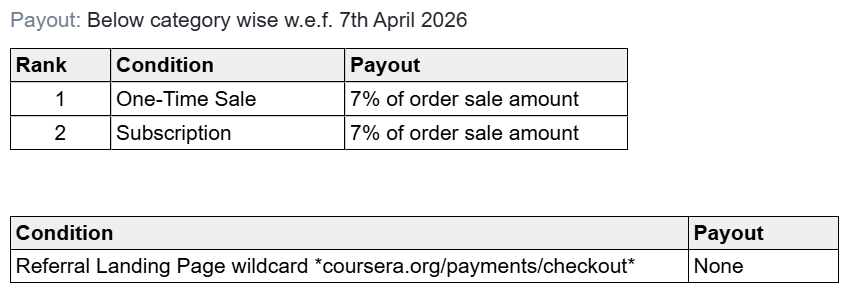
- Payout: 7% flat commission on every successful sale — both one-time course purchases and subscription plans like Coursera Plus.
- The 7% rate is consistent across all product types, making earnings calculation straightforward. A Coursera Plus annual subscription at ₹7,999 earns approximately ₹560 per conversion. Scale that across consistent content traffic and the numbers add up meaningfully.
Cookie Duration
- Cookie window: 30 days — when someone clicks your affiliate link, you receive credit for any purchase they make within the next 30 days. Online learning purchases are often considered decisions — learners browse courses, compare options, and return days later to subscribe. A 30-day cookie captures these delayed conversions.
Tracking and Platform Support
- Tracking: Real-time — monitor clicks, conversions, and pending commissions as they happen through your affiliate dashboard.
- Platform support: Web and mobile web — conversions from both desktop and mobile browsers are tracked and credited.
- Deeplink support: Available — create affiliate links pointing directly to specific courses, certificate programs, or the Coursera Plus pricing page rather than just the homepage. Deep links that take users directly to the course they're interested in convert significantly better than generic homepage links.
- Geo: Worldwide — the campaign accepts traffic from any country, making it suitable for affiliates with international audiences.
Validation Period
- Validation: 55 days — commissions are verified before payout to confirm legitimate conversions. This standard validation window accounts for refunds, payment verification, and subscription confirmation.
Allowed and Restricted Promotion Methods
The Coursera campaign permits several promotional channels while restricting others. Understanding these boundaries prevents wasted effort and compliance issues.
What's Allowed
- Content marketing (blog posts, course reviews, comparison guides, career advice articles)
- Coupon and deal sites
- Cashback platforms
- Telegram channels and communities
- Influencer marketing (YouTube reviews, Instagram content, TikTok)
- Native media buying (sponsored content on discovery platforms)
- Display advertising (banner campaigns on relevant websites)
- Incentive-based promotion
This range gives education affiliates across different traffic types clear paths to earning without running into restrictions.
What's Restricted
- Google Search ads (PPC) — not allowed
- Social media ads (Facebook, Instagram paid campaigns) — not allowed
- Email marketing — not allowed
- SMS campaigns — not allowed
- Push notifications — not allowed
- Pop traffic — not allowed
- Mobile app traffic — not allowed
- Brand keyword bidding — strictly prohibited
These restrictions mean your promotional strategy should focus on organic content, coupon/cashback platforms, Telegram, influencer channels, and permitted display/native advertising. PPC affiliates who rely primarily on Google Ads will need to use other traffic generation methods for this campaign.
Who Should Promote Coursera Offers for Best Results

The Coursera affiliate program performs best with specific publisher types whose audiences naturally overlap with online learning buyers.
Content Creators and Career Bloggers
Writers covering careers, technology, upskilling, or professional development are the most natural fit. A guide on "Best Online Courses for Data Science in 2026" or a review of "Google's Professional Certificates on Coursera" brings in readers who are already close to making a purchase decision. Any affiliate marketing company or individual publisher creating career-focused content will find strong alignment with Coursera offers.
Coupon and Cashback Platform Owners
Learners comparing options or looking for the best price on Coursera Plus are high-intent buyers. A cashback offer or a well-placed coupon code is often the final nudge that completes the purchase. Price-sensitive learners — especially students — actively seek discounts before subscribing.
Telegram Channel Owners
Study groups, career communities, and learning-focused Telegram channels have ready and engaged audiences. Coursera deals perform well in these spaces because members are already in learning mode — they're actively looking for course recommendations and platform deals.
YouTubers and Video Creators
Creators covering education, productivity, career growth, or technology can integrate Coursera reviews naturally into their content. Course walkthroughs, "is Coursera worth it" reviews, and certificate program comparisons build trust through visual demonstration. The 7% commission on annual subscriptions adds up meaningfully when your audience is actively deciding where to invest in their education.
Native and Display Media Buyers
Affiliates experienced with native advertising (Taboola, Outbrain) and display campaigns can use permitted formats to drive traffic at scale — particularly to landing pages built around specific Coursera deals or high-demand certificate programs like Google Data Analytics or IBM Cybersecurity.
Content Strategies That Drive Coursera Conversions
The right content approach determines whether your Coursera promotions generate consistent commissions or sporadic clicks.
Course Review and Comparison Content
Detailed reviews of specific Coursera courses and certificates target buyers at the decision stage:
- "Google Data Analytics Certificate Review: Is It Worth It?"
- "Coursera vs Udemy: Which Online Learning Platform Is Better?"
- "Top 10 Coursera Courses for Career Changers in 2026"
These formats work because the reader has already decided to invest in online learning — they're choosing where, not whether. Your review helps them choose Coursera specifically.
Career Advice Content With Natural Course Recommendations
Articles about career growth, skill development, and industry trends create natural contexts for Coursera recommendations:
- "How to Break Into Data Science Without a Degree"
- "5 Skills Every Marketer Needs to Learn in 2026"
- "How to Prepare for an AI-Driven Job Market"
Within these articles, recommending specific Coursera courses or the Coursera Plus subscription feels helpful rather than promotional. The recommendation solves a problem the reader is actively researching.
Deal and Discount Content
Content built around active Coursera offers captures deal-seeking traffic:
- "Coursera Plus 43% Off: Is Now the Best Time to Subscribe?"
- "Best Coursera Deals and Discounts This Month"
Deal-focused content attracts high-intent buyers who are looking for the best price before committing. Your affiliate link bridges the gap between their intent and the purchase.
Seasonal and Event-Based Content
Certain times of year naturally increase learning demand — New Year resolutions (January skill-building goals), back-to-school periods, career transition seasons (post-layoff cycles), and annual sale events. Planning content around these windows aligns your promotions with peak search intent.
How to Join the Coursera Campaign Step by Step

Getting started with the Coursera affiliate program is a straightforward process.
Step 1: Create Your Affiliate Account
Sign up as an affiliate publisher on the network hosting the Coursera campaign. Complete your profile with your traffic sources — blog, YouTube channel, Telegram community, or advertising platforms.
Step 2: Get Approved and Apply for Coursera
Once your account is reviewed and approved, access your affiliate dashboard. Search for the Coursera campaign and submit your application.
Step 3: Generate Tracking and Deep Links
After campaign approval, generate your unique affiliate tracking links. Use deeplink support to create links pointing directly to specific courses, certificate programs, or the Coursera Plus pricing page. Course-specific deep links convert significantly better than generic homepage links.
Step 4: Create and Publish Content
Build content around Coursera offers, course reviews, and career advice that naturally incorporates your affiliate links. Focus on the content formats and channels that match your audience.
Step 5: Track Performance and Optimize
Monitor clicks, conversions, and earnings through the real-time dashboard. Identify which courses, content pieces, and traffic sources drive the strongest conversion rates. Double down on what works and refine what doesn't.
The same dashboard gives you access to campaigns from other renowned brands across travel, e-commerce, education, utility, and finance — enabling you to diversify your affiliate income beyond a single program. A dedicated account manager is also available to help you choose the right campaigns and optimize performance based on what works best for your portfolio.
Whether you're an independent publisher or working with an established affiliate network, the Coursera campaign provides the tracking infrastructure, commission transparency, and product demand that make education affiliate promotions both sustainable and scalable.
Conclusion
The Coursera affiliate program offers affiliates a 7% flat commission on one of the world's most trusted online learning platforms — backed by partnerships with Google, IBM, Microsoft, and Amazon. With the global online learning market at USD 275.86 billion and growing, the demand for Coursera courses, certificates, and subscriptions is built into the market's trajectory.
The current Coursera Plus deal (43% off annual access) provides a compelling conversion lever. The 30-day cookie captures considered purchase decisions. Worldwide geo targeting opens your promotions to audiences in every country. And permitted channels — content, coupons, cashback, Telegram, influencer, native, and display — give you multiple paths to earning.
Your audience doesn't need convincing that online learning matters. They need the right Coursera offer at the right moment. Create content that delivers both, and let the platform's reputation and pricing do the rest.